
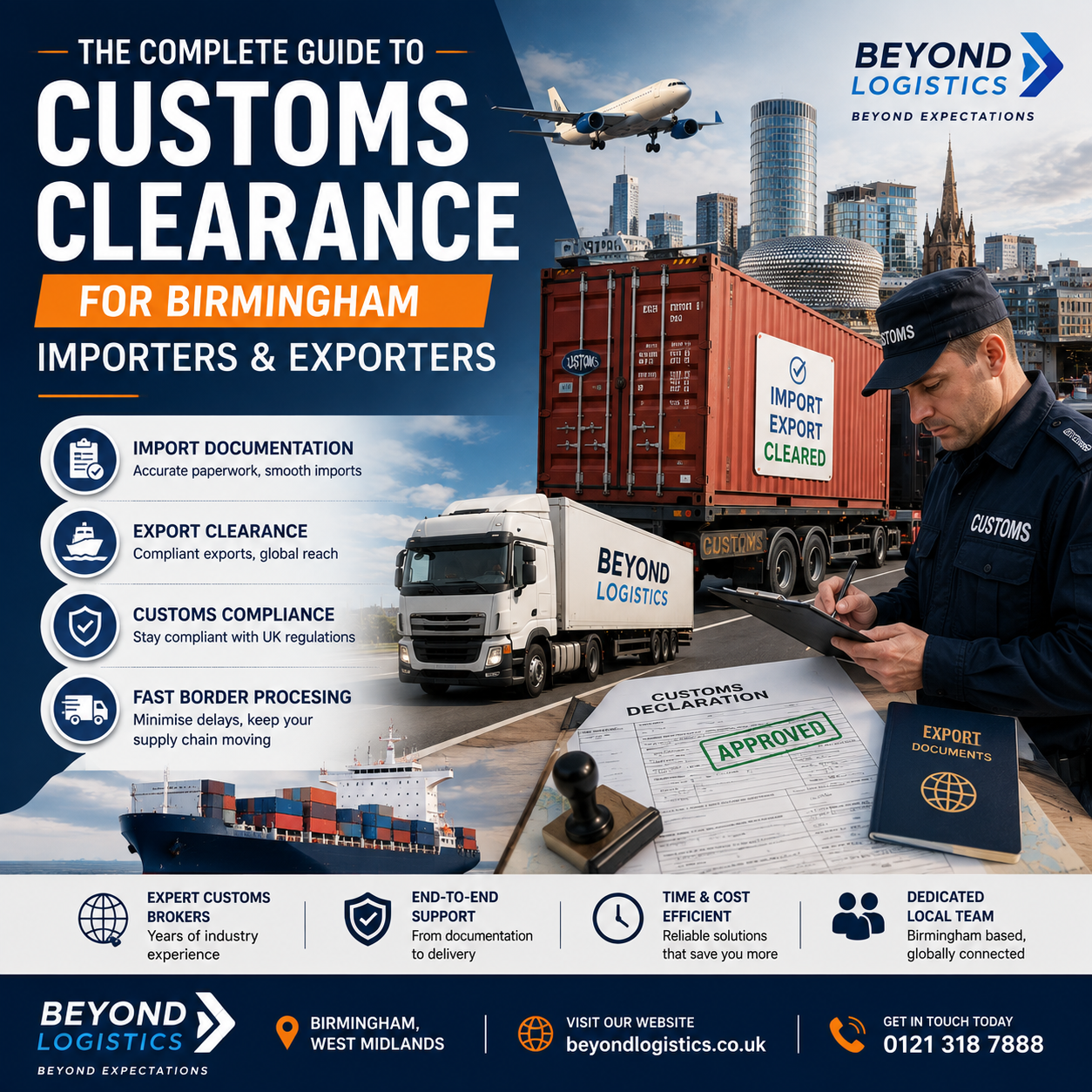
It is at the stage of customs clearance where international consignments either make it or break it. Handle customs clearance efficiently, and your consignment moves through the borders within a few hours; slip up in any commodity code or detail in the invoice, and your goods stay stuck at the port piling up charges for you while your customers wait. This guide addresses everything that you need to know in Birmingham regarding customs clearance, documents, process, post-Brexit laws, and common errors.
A little background on why we are in a position to provide this guide: At Beyond Logistics, customs clearance is not an additional feature to our freight forwarding services, but the key aspect of our job which ensures the movement of consignments on a daily basis from the west midlands across the borders to France, to Asia. The guide is a compilation of what we wished all importers and exporters had read before making their first shipment.
What Is Customs Clearance?
Customs Clearance is the act of making a declaration of cargo at the customs office as the cargo enters an international boundary, payment of any applicable duties or taxes, and authorization to enter or exit the country. In the UK, the declarations are done electronically via the Customs Declaration Service (CDS) to HMRC, and only after clearance can the cargo be delivered or loaded.
Customs clearance is mandatory for all commercial shipments. There is no value below which customs clearance becomes unnecessary, not even a single sample that will be exported to an EU customer since Brexit.
What Documents Do You Need for Customs Clearance in the UK?
In most cases, the reason behind delayed clearances is that the UK customs documentation is not complete or consistent. The following documents are required for any commercial shipment:
- Commercial invoice. The most important document , used by customs to determine the duties and VAT, it needs to provide information about the exporter, importer, description of the goods, quantities, unit and total value of the shipment, currency, origin and HS codes of the goods, and agreed Incoterm. “Machine parts, £500” is unacceptable, but “20 × stainless steel flange bearings, HS 8482.10, origin DE, EXW Stuttgart, €480” will be fine.
- Packing list. Similar to the invoice, it indicates how the items are packed physically, cartons, pallets, weights, and dimensions. It is used by customs for inspection and by the carriers for handling.
- Transportation documents. Bill of lading for sea transport, Air Waybill for air transport, and CMR for road transport. It confirms the contract of carriage and who is entitled to deliver the items.
- Certificate of origin (if required). According to the UK-EU Trade and Cooperation Agreement, any item of origin UK/EU trades free of duties – provided the item of origin is correctly declared. Otherwise, if incorrectly declared, the duty on items eligible to cross at 0% will be 100%.
- Licenses and Certificates (Product Specific). For foodstuffs, plants, chemicals, medical equipment, and dual-use products, there are extra requirements such as health certificates, import licenses, or conformity certificates.
This regulation applies to all of the above and is a key one all documents should be consistent. An inconsistency in the weight in the invoice vs packing list or in the value in the transport document will certainly lead to a customs inquiry.
What Is a Commodity Code and Why Does It Matter?
The HS Code (Commodity Code) is a 10-digit identification code which specifies to HMRC precisely what kind of good it is and defines the duty percentage, VAT treatment, and restrictions on it. First six digits of it are standardized worldwide while the remaining four digits are specific to the UK.
Misclassification is the biggest blunder when it comes to importing. You either pay way more than necessary duty on every shipment in years to come or you underpay which leads to back-tariffs along with penalties during the audit process. Do not blindly accept your supplier’s HS code suggestion since their export HS code does not necessarily have to be the same as your import HS code. The Government provides a handy tool called Trade Tariff on the gov.uk website to help you with this.
Post-Brexit Basics: What Changed for Birmingham Traders?
- From 1 January 2021, UK-EU trade follows the same rules as international trade outside of the EU. This means that:
- All UK-EU business transactions require an export declaration and an import declaration. The pre-2021 practice of free movement of goods no longer applies.
- You must have an EORI number beginning with GB to conduct any business transactions. It can be obtained for free from HMRC in around a week.
- The rules of origin determine if you are liable for any customs duties. Tariffs on UK-EU trade do not apply only to goods with the right origin statement and that are considered originating. Goods simply being passed through the UK (for example, Chinese goods re-exported from the UK to Ireland) are not considered.
- The business can account for Import VAT and this means the benefit of Postponed VAT Accounting. Businesses registered for VAT can declare Import VAT via the VAT return instead of paying it at the border, a cash flow benefit which many traders are missing out on.
- Borders are very much alive and kicking. Sanitary and phytosanitary controls on foods and plant-based products have been toughened up gradually via the Border Target Operating Model, and what used to be a careless mistake now results in the delay of a whole trailer load of cargo.
- This is where the sting is for businesses who enjoyed trading with Europe prior to 2021, and it is one of the reasons why post-Brexit customs assistance is among the most requested services at our Birmingham offices.
What Is an ATA Carnet and When Do You Need One?
The ATA Carnet is a customs document allowing the temporary export of goods outside of the country for up to 12 months with no payment of duties or import VAT on the condition of their reimportation back into the UK. This Carnet is issued in the UK by the London Chamber of Commerce and Industry and accepted in over 80 countries.
Businesses from Birmingham usually use ATA Carnets for exhibiting products in exhibitions or trade shows and for equipment (cameras, measuring devices, tools which accompany engineering teams abroad) and commercial samples used abroad but not sold. The problem is that this Carnet has to have stamps in each point of passage both on the way out and on the way back. Without this stamp, a business risks losing the security deposit (percentage of value of goods). For those cases when the goods are not re-imported but sold abroad, Carnet is not appropriate and standard export declaration should be applied instead. We’ve described ATA Carnets in details in our ATA Carnet guide, but for temporary exports this Carnet could make all the difference in your customs charges.
How Customs Clearance Takes Place, Point-by-Point
- Pre-shipment: verify commodity codes, Incoterms, and status as originating; obtain invoice and packing list; determine licensing requirements.
- Declaration: your customs broker will submit the export/import declaration to HMRC via CDS, before the cargo arrives at the border.
- Risk assessment: HMRC’s computers will either allow passage of the cargo, ask for documentation, or examine it physically.
- Duties and VAT: based on the declared value and commodity code, payment can be made through your deferment account or postponed using PVA.
- Release: your goods are cleared for delivery or export shipment. If your preparation has been thorough, the entire process can be done in hours.
The problem doesn’t lie in the system itself but rather in the inputs. Now we have reached the mistakes worth mentioning.
The Five Mistakes That Hold Shipments at the Border
- The description of goods on the commercial invoice is vague.
- Incorrect commodity codes or guessed codes used.
- The origin declared is not supported by any documentation in order to be considered duty free.
- An attempt to undervalue goods in order to pay less duties HMRC sees this as fraud rather than discount.
- The discrepancy between the documentation provided regarding the value or weight/quantity of the goods.
All of these mistakes can be avoided prior to sending the goods out. This is the real reason why one should use a custom broker in Birmingham. It’s not because of the complexity of the process of declaration itself, but because the professional will see all those mistakes and fix them.
Frequently Asked Questions
What is the processing time for customs clearance in the UK?
Provided the documentation is correct, the clearance process will usually be done within a few hours after acceptance of the declaration. Document checks or inspection of the cargo may take up to several days. The key determinant of the speed of clearance is the correctness of the documentation.
What is the cost of customs clearance?
The fees charged by the agent for a regular UK import/export declaration will usually be around £25 – £75 per declaration, depending on complexity. In addition to that there will be duties and import VAT to be paid on the shipment based on the commodity code, value, and country of origin.
Do I need a customs agent or can I declare myself at customs?
Legally, it is possible to self-declare via the CDS system, but you need access to software, registration on CDS and knowledge about commodity classification and valuation. In practice, most SMEs find it more convenient to use an agent, as it works out cheaper in the end.
Do I need to make customs declarations for imports from the EU?
Yes. All commercial goods moved between the UK and the EU since January 2021 will need full customs declarations on both sides. Tariff-free status under the UK-EU trade deal only applies to goods of qualified origin with the correct paperwork.
What is an EORI number?
An EORI (Economic Operator Registration and Identification) number is your business’ customs ID and is necessary for all commercial imports and exports. UK businesses need a GB-numbered EORI number, which is freely available from HMRC and usually comes through within a week.
Can I claim back import VAT?
Import VAT will be recoverable by VAT-registered companies as input tax and, through Postponed VAT Accounting, it can even be claimed back from the same VAT return that you declare it on. This means that nothing has to be paid to customs when you import.
Get Customs Clearance Handled Properly
Customs does not reward creativity. Customs rewards accuracy, consistency, and preparation ahead of time, and that is something which most companies would like to acquire but don’t want to create.
Beyond Logistics offers complete customs clearance services in Birmingham – import/export declarations, checking of commodity codes, advice on ATA Carnets, and customs compliance, in addition to our logistics services, from 4 Henley Cres, Birmingham, Solihull B91 2JD. All of this under one roof, one point of contact and paperwork that gets cleared the first time around.
Contact us at +44 (0)121 318 7888 or beyondlogistics.co.uk for your next shipment. Your one hundred and fifty-first declaration or your first, we will ensure that you get past the border as easily as possible.